Choosing a Wine Cooler: What Most Guides Don’t Tell You
Temperature zones, real bottle counts and touch-to-open doors: the wine cooler trade-offs most guides skip, explained by Kitchen Avenue in Lebanon.
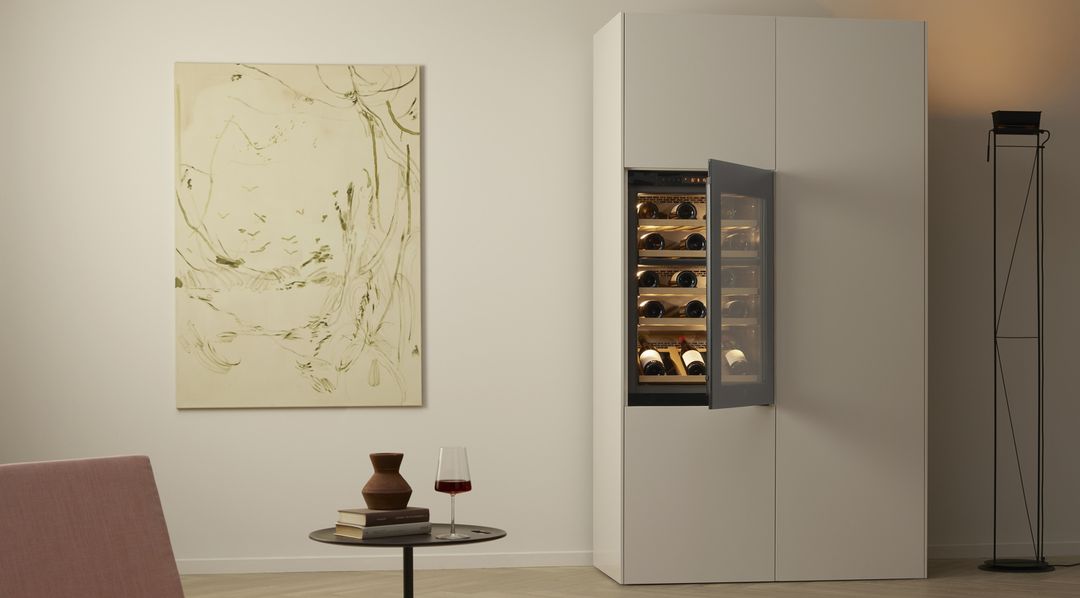
Choosing a wine cooler comes down to three decisions: how many temperature zones you need, how you want your bottles displayed, and how the door should open. Each one involves a trade-off, and the biggest is between convenience and capacity.
Most guides cover the basics and stop there. After years of planning wine coolers into kitchens, here is what we tell our clients, including the details that rarely make it into a brochure.
The basics: why a wine cooler, not a fridge
A kitchen fridge is designed to keep food cold, at around 4°C. That is too cold for wine, and the air inside is dry and the temperature shifts every time the door opens. A wine cooler is built for the conditions wine needs:
A stable temperature, set for wine rather than food
Controlled humidity, so corks do not dry out
Low vibration, so wine can rest undisturbed
UV-protected glass, because light harms wine over time
Shelves that hold bottles horizontally, keeping the cork in contact with the wine
Wine coolers come built-in, to sit flush within your cabinetry, or freestanding. Built-in models need the right ventilation to perform well inside a cabinet, so they are best planned with the kitchen.
One, two or three temperature zones
Each zone is a separately controlled compartment with its own temperature. As a general guide, sparkling wine is served at around 6 to 8°C, whites at 8 to 12°C and reds at 15 to 18°C, while long-term storage suits all wines at around 12°C.
One zone keeps every bottle at the same temperature. It works in two ways: as a storage cellar, where all your wine ages at a steady 12°C, or as a serving fridge for the style you drink most.
Two zones let you keep reds and whites ready to serve at the same time, or store wine in one zone and chill bottles for serving in the other. For most households, this is the most practical choice.
Three zones give you a storage zone plus separate serving zones for reds and for whites or sparkling. They suit serious collectors and those who entertain often.
One point people often overlook: “room temperature” for red wine means 15 to 18°C, not the temperature of a warm Lebanese living room. A dedicated red zone means your reds are served as the winemaker intended, rather than too warm.
The hidden trade-off: more zones, fewer bottles
This is the part brochures rarely spell out. Every extra temperature zone costs you bottles.
Each zone needs its own insulated separation, its own air circulation and its own temperature control. That takes space inside the cabinet, and the shelves can no longer run continuously from top to bottom. The more zones you add, the more of the interior goes to keeping them apart.
Our ASKO undercounter wine climate cabinets show it clearly. The one-zone and two-zone versions have exactly the same outer dimensions, yet the one-zone model holds up to 44 bottles and the two-zone model up to 38. Adding a second zone costs six bottles, or around 14% of the capacity.
So before choosing more zones, ask yourself how you actually drink. If you mostly store wine and chill a bottle when needed, one zone gives you the most space. If you regularly serve reds and whites side by side, a second zone is worth the bottles it costs.
Display or capacity: the real bottle count
The second trade-off is between how your wine looks and how much of it fits.
The bottle count on a datasheet is a maximum. It usually assumes standard 0.75-litre Bordeaux bottles, packed in the densest arrangement the shelves allow, often stacked on top of each other. Wider bottles such as Burgundy, Champagne or magnums take more room, so the real number is lower.
Then there is how you use the shelves. In the kitchens we install, we often fit one bottle per rack, laid out neatly with the labels visible. It looks beautiful and makes every bottle easy to find and take out. It also means fitting far fewer bottles than the datasheet figure, sometimes only around half.
There is no right answer, only the right balance for you:
For a collection you add to and age, prioritise capacity and stack bottles on storage shelves
For wine you drink and entertain with, prioritise display and easy access, one bottle per rack
For both, combine them: a few display shelves at eye level for the bottles you will open soon, with denser storage below
Why touch-to-open models work so well
A touch-to-open wine cooler has no handle. A light press on the glass opens the door, and on many models a soft-close mechanism closes it gently. It is a small detail that makes a real difference:
It looks better. A clean sheet of glass, with nothing interrupting it, gives the wine cooler a sleek, furniture-like finish.
It suits handleless kitchens. If your cabinets have no handles, adding one just for the wine cooler breaks the line. A touch-to-open door keeps the design consistent.
It is easier to match. Handles are where appliances from different brands clash most: different shapes, finishes and lengths. Without one, a wine cooler sits comfortably beside ovens and fridges from another brand.
Our ASKO undercounter wine climate cabinets, for example, have a push-to-open, soft-close door.
Panel-ready models: show the wine or hide it
A panel-ready wine cooler takes a front made from the same material as your cabinets, so it becomes part of the kitchen rather than an appliance set into it. The panel also gives you a design choice that most people do not realise they have.
Keep the centre of the panel open. The panel forms a frame, and the glass door shows through the middle. Your bottles stay on display, lit from inside, while the frame ties the wine cooler into the surrounding cabinetry.
Close the panel completely. The wine cooler disappears behind a solid front that matches the rest of the kitchen. Nothing is on show, for a discreet, minimal look.
The open frame suits a kitchen where the wine is part of the design. The closed panel suits a calm, handleless kitchen where you would rather the appliances stay out of sight. Our PROHAUS panel-ready wine coolers, built-in and undercounter, can be finished either way.
A connected wine cooler: know what is happening inside
The problems that spoil wine happen quietly. A door left slightly ajar, a gradual drift in temperature or humidity falling too low: none of it is visible from outside, and you usually find out only when you open a bottle that is past its best.
Our ASKO wine coolers connect to the ConnectLife app, so you can follow what is happening inside from your phone:
Temperature and humidity in each zone, with the option to change settings remotely
An inventory of your wine: where each bottle sits, how long it has been stored and the temperature to serve it at
The three-zone ASKO cabinet goes further. Its humidity, temperature and vibration sensors send warnings to the display and the app, so you know about a problem as soon as it starts. It is also connected to Vivino, the wine app: a built-in camera scans each label, recognises the wine and adds it to your inventory.
The inventory also helps with the capacity trade-off. When bottles are stacked densely to make the most of the space, the app tells you exactly where each one is, so you can store more without losing track.
Which set-up is for you?
If you… | Consider |
Mainly store wine and want the most bottles | One zone, storage shelves |
Serve reds and whites regularly | Two zones |
Collect seriously and entertain often | Three zones, with display and storage shelves |
Want your wine on show | Display shelves, one bottle per rack |
Have a handleless kitchen or mix appliance brands | A touch-to-open door |
We carry wine coolers from V-ZUG, ASKO and PROHAUS, built-in and freestanding, from undercounter models to full-height cabinets. Visit our Jdeideh showroom to see them, or talk to our team about planning one into your kitchen. We deliver and install free of charge throughout Lebanon, with a 2-year warranty.
Frequently asked questions
Why does my wine cooler hold fewer bottles than advertised?
The advertised figure usually assumes standard Bordeaux bottles packed as densely as possible. Wider bottles, display shelving or one bottle per rack all reduce the real number.
Do more temperature zones mean fewer bottles?
Yes. Each zone needs its own separation and air circulation, which takes space. Our ASKO undercounter cabinets hold up to 44 bottles with one zone and up to 38 with two, in exactly the same size.
What temperature should a wine cooler be set to?
For long-term storage, around 12°C suits all wines. For serving, around 6 to 8°C for sparkling, 8 to 12°C for whites and 15 to 18°C for reds.
Can I keep wine in my kitchen fridge?
For a few days, yes. For longer, a fridge is too cold and too dry, and its temperature changes every time the door opens. A wine cooler keeps wine at a stable temperature and humidity.