Gas Oven or Electric Oven: Which Should You Choose?
Gas oven or electric oven? Compare heat, temperature control, functions and installation, and see which suits your kitchen in Lebanon.
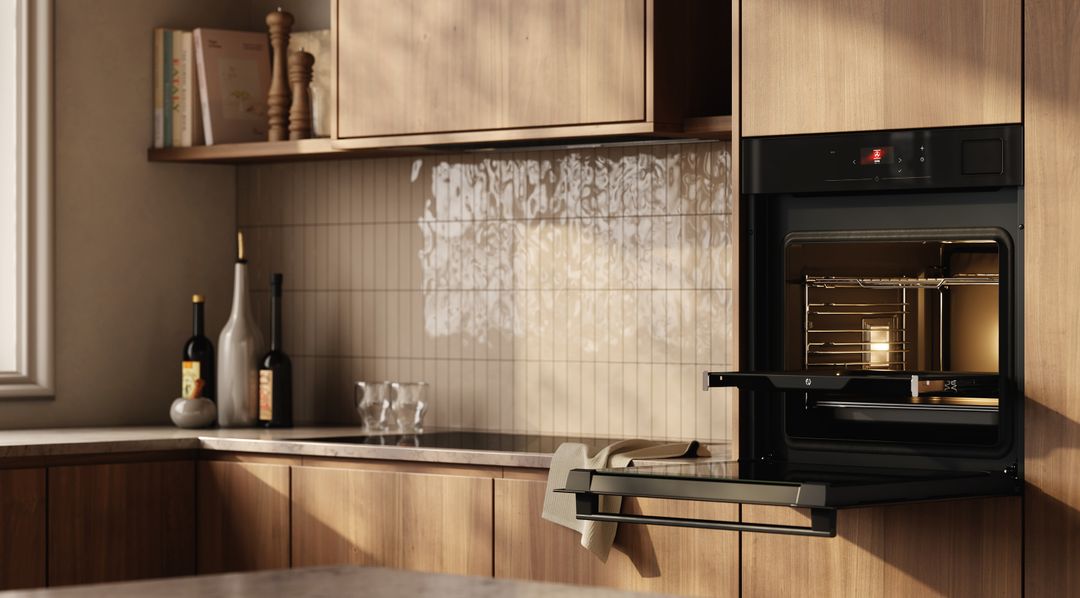
For a modern built-in kitchen, we recommend an electric oven. It heats more evenly, holds its temperature more precisely and offers far more cooking functions than a gas oven.
Gas ovens have a long history in Lebanon, and many families grew up cooking with one. They are simple to use and draw very little electricity, so the question comes up in almost every kitchen we plan. Here is how the two compare, and when each one makes sense.
How each oven heats
A gas oven heats with a burner at the bottom of the cavity. Hot air rises, so the top of the oven runs hotter than the bottom, and the area near the burner hotter than the front. Trays often need turning or moving halfway through to cook evenly.
An electric oven heats with elements at the top, bottom and back, usually with a fan that circulates the air. Heat reaches the food evenly from every side, so a tray cooks the same at the front as at the back, and on the top shelf as on the bottom.
Temperature control and cooking results
A gas oven controls its temperature by turning the flame up and down, so the heat inside swings around the setting. The dial is often marked in gas marks or broad steps rather than exact degrees.
An electric oven lets you set the temperature to the exact degree and holds it there. That precision matters most for baking. Cakes rise evenly, pastry browns uniformly and biscuits come out the same across the whole tray. With fan cooking, you can also bake on two or three levels at once, which is difficult in a gas oven.
Gas heat is slightly moister, because burning gas releases water vapour, and some cooks like it for roasting. Many modern electric ovens go further, with dedicated roasting modes, a food probe that monitors the core temperature of meat, and steam-assisted cooking on some models.
Functions and features
A gas oven usually offers one baking mode and a grill. An electric oven gives you a full set of tools for different dishes:
Fan cooking for even results on several levels at once
Top and bottom heat for traditional baking and slow cooking
Grill modes for browning, gratins and grilling meat
Automatic programmes that set the temperature, mode and time for a chosen dish
A food probe that tells you when meat or fish is cooked to the core
Pyrolytic self-cleaning, which turns grease into ash you simply wipe away, available on our ASKO Craft pyrolytic ovens
App control on selected ASKO and V-ZUG ovens, to monitor cooking from your phone
Our ASKO ovens can also be recalibrated years into their life, restoring their original temperature accuracy.
Installation, placement and running
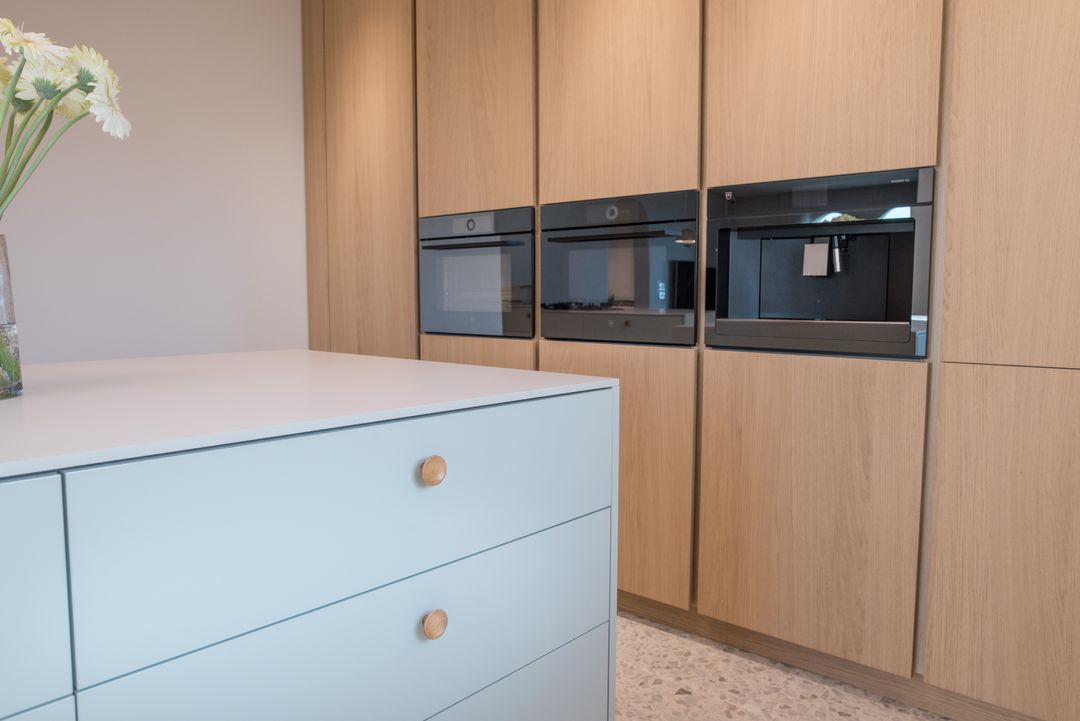
Placement. In Lebanon, gas ovens are usually 90 cm units installed beneath the hob, close to the floor. An electric oven can be built into a tall unit at eye level, so you can check and handle dishes without bending. That is also safer when lifting heavy, hot trays.
Connection. A gas oven needs a gas supply, either a line or a cylinder, and good ventilation. A built-in electric oven needs a dedicated circuit, typically protected by a 10 A to 16 A fuse depending on the model. Our team checks your electrical installation before fitting the oven.
Electricity use. A gas oven draws very little electricity, which is one reason it remains popular. An electric oven uses more, but a 60 cm oven reaches temperature quickly and is more than large enough for almost every household, including kibbeh trays and family-sized roasts.
At a glance
Feature | Gas oven | Electric oven |
Heat distribution | Hotter at the top and near the burner | Even throughout the cavity |
Temperature control | Approximate; heat swings around the setting | Set to the exact degree and held |
Baking on several levels | Difficult | Easy with fan cooking |
Cooking functions | Usually one baking mode and a grill | Fan, top and bottom heat, grill modes, programmes |
Food probe, pyrolytic cleaning, app control | Rarely available | Available on selected models |
Typical placement | 90 cm unit beneath the hob | Tall unit at eye level, or under the counter |
Connection | Gas line or cylinder, plus ventilation | Dedicated circuit, 10 A to 16 A |
Electricity use | Very low | Higher |
Which one is for you?
Choose an electric oven if:
You bake often and want even, predictable results
You want to cook on several levels at once
You value precise temperature control and a wide range of functions
You would like the oven at eye level in a tall unit
Choose a gas oven if:
You are used to cooking with gas and prefer how it feels
You want a 90 cm oven beneath the hob
Keeping electricity use low is a priority
Our recommended set-up
Our preferred configuration is a tall unit with a 60 cm electric oven and, above it, a compact steam oven or combi microwave oven. Both sit at a comfortable height, and you have two cooking spaces you can use at the same time.
If you prefer gas, many of our clients choose a 90 cm gas oven beneath the hob, paired with a compact steam oven or combi microwave oven in a tall unit. It offers a similar combination of cooking options. Not sure which of those two suits you? Read our guide to choosing between a microwave oven and a steam oven.
Our V-ZUG and ASKO ovens are on display and switched on at our Jdeideh showroom, so you can see them working before you decide. We deliver and install free of charge throughout Lebanon, with a 2-year warranty.
Frequently asked questions
Is an electric oven better for baking?
Yes. Even heat and precise temperature control are what baking depends on. Cakes rise evenly, pastry browns uniformly, and with fan cooking you can bake several trays at once.
Can I have a gas hob with an electric oven?
Yes, and it is a very common combination in Lebanon. Many clients keep a gas hob for everyday cooking and install an electric oven in a tall unit at eye level.
Does food taste different from a gas oven?
Gas heat is slightly moister, which some cooks like for roasting. With a food probe, dedicated roasting modes and steam-assisted cooking on some models, a modern electric oven gives you more control over the result.
Which oven is easier to clean?
An electric oven with pyrolytic self-cleaning. It heats to a very high temperature and turns grease into fine ash that you wipe away, with no scrubbing or chemical cleaners.